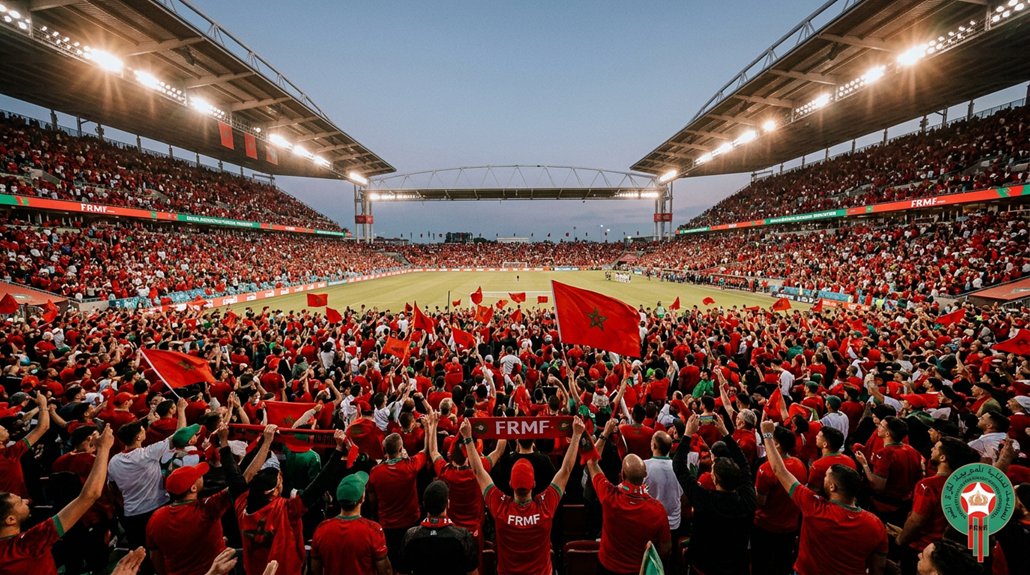
Morocco’s case rests on scale. The 115,000-seat Hassan II Stadium near Casablanca, already 30% complete, would surpass Bernabéu and Camp Nou as the world’s largest football venue. Backed by African Development Bank loans for rail and motorway links, plus six renovated stadiums nationwide, Morocco is building infrastructure, not just a venue. Spain still leans on prestige and political favor, but Morocco’s purpose-built centerpiece keeps its final bid credible. The details behind that competition reveal more than stadium capacity alone.
A 115,000-Seat Stadium That Outsizes Spain’s Bernabéu and Camp Nou
At the heart of Morocco’s bid sits a stadium built to make a statement. The Hassan II Stadium, rising near Casablanca in Benslimane, is designed to hold roughly 115,000 spectators, a scale that would make it the largest football-specific venue in the world once complete. That figure dwarfs Spain’s leading candidates: Santiago Bernabéu’s renovated capacity sits between 78,000 and 83,000, while Camp Nou’s redevelopment plans point toward around 105,000 seats. Construction on Hassan II is set to be completed by the end of next year. Once finished, the venue is expected to join the ranks of Morocco’s other home venues used for competitive matches, friendlies, and major tournaments.
For FRMF president Fouzi Lekjaa, this size differential is not incidental. He has repeatedly argued that the opening match and final should go to “the largest stadium ready for the 2030 World Cup,” a criterion Hassan II appears built to satisfy, and one Spain’s stadiums, however storied, cannot currently match.
Casablanca’s World Cup Stadium: Construction Progress and Timeline
Numbers on paper mean little without a construction site to back them up, and Hassan II Stadium’s is now impossible to ignore. Ground-breaking came in late 2024, and by May 2026, Reuters found the project roughly 30% complete after nine months of main structural work, with around 40% of the tribunes built.
Crews work three shifts a day, seven days a week, with 5,000 workers on site heading toward a peak of 10,000. The seating bowl is already legible, and the roof lattice and stair towers are taking shape in El Mansouria. With earthworks nearly finished and the 3.7 billion dirham roof-and-façade contract underway, officials still target completion by the end of 2027. This ambitious project reflects the broader momentum behind the Atlas Lions and Morocco’s growing football infrastructure nationwide. The stadium is designed to hold 115,000 seats, which would make it the largest soccer venue in the world.
The Roads, Rails, and Stadiums Powering Morocco’s 2030 Bid
Beyond the stadium walls, Morocco’s bid rests on an infrastructure push too large to dismiss as bureaucratic ambition.
This isn’t a stadium project—it’s a statement of intent, backed by billions in concrete and steel.
The African Development Bank has already committed serious money to back it, approving loans of €650 million and €205 million aimed squarely at transport links tied to the World Cup. This financing still needs to be submitted to the AfDB board for approval.
That funding is going toward rail lines, motorways, and airport upgrades designed to move fans efficiently into Benslimane, where the Grand Stade Hassan II is taking shape.
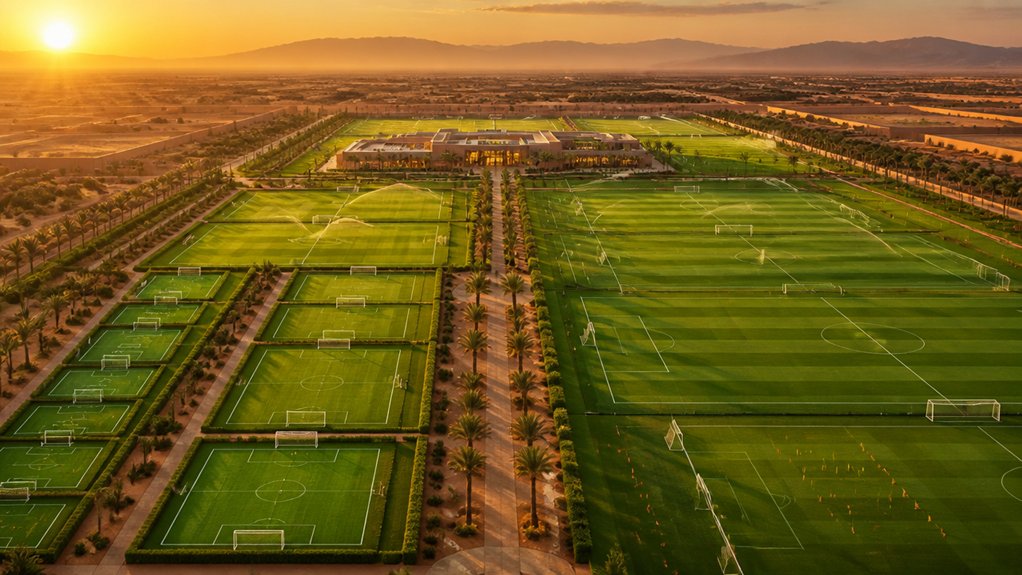
Alongside the new build, Morocco plans to renovate six existing stadiums, broadening capacity across the tournament rather than relying on one venue. On the player development side, the Mohammed VI Football Academy continues to feed elite homegrown talent into the national pipeline, reinforcing the sense that Morocco is building for the long term, not just for one tournament.
Taken together, the stadium and its surrounding transport network suggest a country planning for a single-hub mega-final, not just hoping for one.
Morocco vs. Spain: Who Wins the World Cup Final Race?
Two men, two federations, and one trophy match still without an address: that, fundamentally, is where the race for the 2030 World Cup final stands.
Rafael Louzan has declared, without naming a stadium, that Spain will host it, leaning on the Bernabéu’s prestige and Camp Nou’s delayed renovation as evidence of Spanish readiness.
Morocco counters with sheer scale: a proposed 115,000-seat stadium near Casablanca that would dwarf every rival venue and become the tournament’s centerpiece by design rather than reputation. That stadium, inspired by a traditional Moroccan tent, is being built by Populous. This ambition mirrors Morocco’s broader rise as a football nation, built on years of structural investment in talent development that has already elevated the national team onto the global stage.
Reports of Spain and Portugal privately favoring the Bernabéu, while sidelining Morocco’s Casablanca push, suggest the political groundwork still tilts toward Europe.
Yet Morocco’s stadium ambition, paired with its broader infrastructure push, keeps its case credible until FIFA settles the matter.
Get the Atlas Lions Weekly
The biggest Morocco football stories, player updates and analysis—delivered to your inbox every Sunday.