Mohamed Ouahbi has named 29 players for Morocco’s opening AFCON 2027 qualifiers against Gabon and Lesotho, in his first squad announcement since the 2026 World Cup. The group comprises four goalkeepers, 10 defenders, eight midfielders and seven forwards and has also been called up for the friendly against Ghana. Hakimi’s suspension and El Kaabi’s injury complicate matters. The full breakdown reveals how Ouahbi plans to manage the international window.
Ouahbi Names Morocco Squad for AFCON 2027 Qualifiers
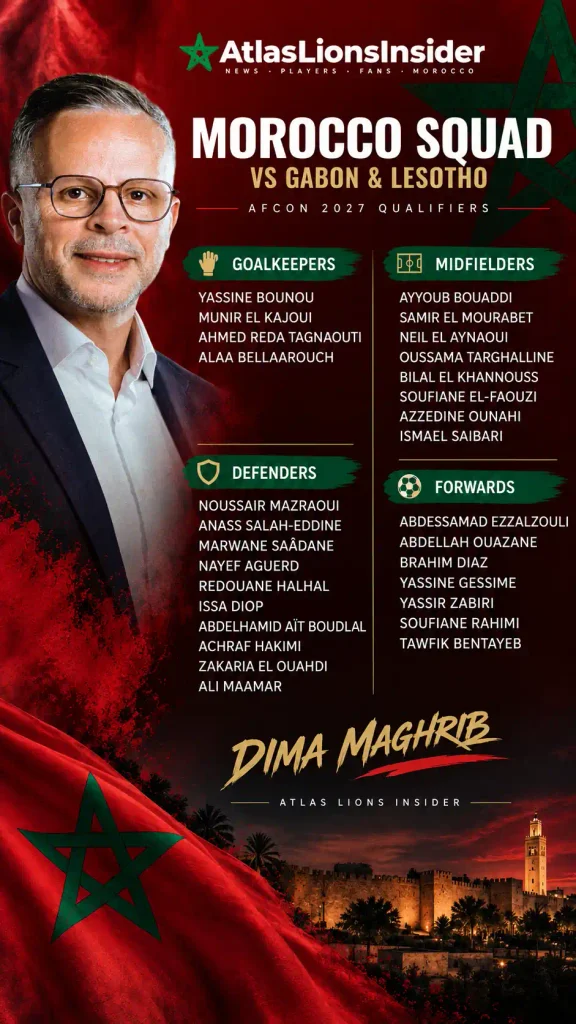
Mohamed Ouahbi revealed his first squad list since Morocco’s 2026 World Cup campaign, naming 29 players for the upcoming international window, which includes AFCON 2027 qualifiers against Gabon and Lesotho and a friendly against Ghana.
The announcement came on Thursday, 17 September 2026, during a press conference at the Mohammed VI Football Complex in Maâmora, near Rabat.
The list breaks down into four goalkeepers, 10 defenders, eight midfielders and seven forwards, striking a balance between established figures from the World Cup squad and emerging talents Ouahbi has been monitoring. The squad includes established internationals such as Achraf Hakimi, Brahim Díaz, and Yassine Bounou. For a full breakdown of every player and their role within the team, fans can consult the Morocco national team squad guide.
Morocco face Gabon at home before travelling to Bloemfontein to face Lesotho, with both fixtures forming the start of their qualifying campaign for AFCON 2027, jointly hosted by Kenya, Tanzania, and Uganda.
Full Squad List: Ouahbi Names 29 Players
The headline number from Maâmora is 29. Ouahbi has called up a 29-player squad for the international window covering Morocco’s AFCON 2027 qualifiers against Gabon and Lesotho and the subsequent friendly against Ghana.
Broken down, the 29-player squad includes four goalkeepers, 10 defenders, eight midfielders and seven forwards, with Bounou, Hakimi and Mazraoui providing experience alongside younger inclusions such as Bellaarouch and Ouazane. Bounou himself remains the heart of the Atlas Lions between the posts, a veteran presence whose experience continues to underpin the squad’s goalkeeping department.
The 29-player selection gives Ouahbi considerable flexibility across three fixtures during the international window.
Breaking Down the Positional Split: 4-10-8-7
Four goalkeepers, 10 defenders, eight midfielders and seven forwards: the shape of Ouahbi’s 29-player squad tells its own story before a ball is kicked.
Between the posts, Bounou remains the clear No.1, with Munir El Kajoui and Tagnaouti offering tournament-ready cover and Bellaarouch representing the next generation. Tagnaouti’s inclusion reflects his standing as Morocco’s resilient goalkeeper, a role he has embraced across major tournaments with the Atlas Lions.
The back line is the heaviest unit, and deliberately so. Hakimi, Mazraoui and El Ouahdi give Morocco elite right-sided depth; Salah-Eddine provides a natural left-sided option; Maamar can operate on either flank; and Aguerd, Diop, Saadane, Halhal and Ait Boudlal supply central steel.
That spread allows Ouahbi to switch between back-three and back-four systems without compromise.
Midfield and attack, with eight midfielders and seven forwards, favour flexibility over volume—enough creative and physical variety to adapt formations without diluting quality, reflecting a squad built for control as much as chances.
This depth comes as the nation’s football profile continues to rise on the global stage, with Morocco set to co-host the 2030 World Cup alongside Spain and Portugal.
Morocco’s Group A Rivals and Qualifying Stakes
Every squad announcement means little without context, and Morocco’s comes with a clearly defined task: finish in the top two of Group A to reach the 2027 finals. The Atlas Lions were drawn alongside Gabon, Niger, and Lesotho, a group that looks manageable on paper but carries genuine risk.
Gabon stands out as one of Morocco’s main rivals in the group, while Niger enter the campaign under new coach Nabil Neghiz following the departure of former Morocco boss Badou Zaki. Lesotho, while considered the outsider, remains capable of disrupting a short campaign if underestimated. Morocco will look to draw on the confidence built during Morocco’s longest unbeaten run as they navigate this qualifying campaign without slipping into complacency.
With only two qualification spots available, Morocco can afford few slip-ups. The priority is consistency rather than dominance—avoiding dropped points against Niger or Lesotho while managing the sterner test posed by Gabon. Qualifying will unfold across three separate windows, with the third window running from March 22–30, 2027, giving Morocco little room to recover from early missteps.
Morocco’s Road to AFCON 2027 Starts Against Gabon
Gabon’s presence at the top of Group A gives Morocco’s opening fixture an early significance that qualifiers don’t always carry. The two sides meet on 25 September 2026 at the Prince Moulay Abdellah Stadium in Rabat, kicking off at 19:00 GMT (20:00 local), with South African referee Abongile Tom taking charge.
It marks the start of a compact opening window, with Morocco travelling to Bloemfontein just four days later to face Lesotho on 29 September, this time under Cameroonian official Abdou Abdel Mefire.
Coming into the campaign as reigning AFCON champions and hosts of the 2025 tournament, Morocco enter as Group A’s clear headline act, and a strong start against Gabon would settle any early nerves before the trip south.
Gabon Clash in Rabat: What to Expect
Two points separate ambition from anxiety in Group A, and Morocco’s opener against Gabon carries enough weight to shape early perceptions of the qualifying race.
Set for 25 September 2026 at the Complexe Sportif Prince Moulay Abdellah in Rabat, kick-off is scheduled for 19:00 GMT, with South African official Abongile Tom taking charge.
Alongside Niger and Lesotho, only two sides from this quartet advance directly to the 2027 finals, making Matchday 1 results disproportionately influential over a six-match campaign.
Gabon arrive with a reputation for physical, direct football, likely testing Morocco’s build-up play and defensive shifts under Mohamed Ouahbi.
CAF has flagged this fixture among its headline Matchday 1 clashes, fitting company for a Group A opener with genuine early stakes.
Away Test in Bloemfontein: Morocco vs Lesotho
Four days after the Rabat opener, Morocco’s attention turns south to Bloemfontein, where Lesotho await in a fixture carrying its own tactical weight despite the gulf in continental standing between the two sides.
Set for September 29, the match unfolds not in Lesotho itself but at a neutral South African venue, a logistical detail that Ouahbi’s staff will have factored into their travel and recovery planning between the two qualifiers.
With 29 players named across four goalkeepers, 10 defenders, eight midfielders and seven forwards, the coach has considerable options to rotate across the international window.
Figures like Yassine Bounou, Achraf Hakimi and Brahim Díaz provide continuity, while the squad’s blend of experience and youth suggests Ouahbi is using these fixtures to test depth as much as secure points.
Why Is Lesotho Hosting Morocco in South Africa?
Beneath the surface of a routine fixture list lies a straightforward infrastructure problem: Lesotho has no stadium approved by CAF to host senior international football.
LeFA has acknowledged as much, admitting the country remains without a venue meeting international standards, forcing officials to look abroad for CAF-compliant facilities.
That search has led to Toyota Stadium in Bloemfontein, already confirmed for the 29 September 2026 qualifier against Morocco and other Lesotho fixtures, including one against Seychelles.
CAF’s approval process weighs pitch quality, safety, broadcast capability, and spectator infrastructure—criteria Lesotho’s domestic grounds currently fail to meet.
Toyota Stadium in Bloemfontein is the confirmed venue for the September 29 qualifier, with Cameroonian referee Abdou Abdel Mefire appointed to take charge.
Yassine Bounou Leads a Stacked Goalkeeping Quartet
A quartet of goalkeepers anchors Mohamed Ouahbi’s squad for Morocco’s opening 2027 AFCON qualifiers, with Yassine Bounou standing as the clear senior reference point.
Four goalkeepers anchor Ouahbi’s squad, with Yassine Bounou standing firmly as Morocco’s senior reference point.
He is joined by Munir El Kajoui and Ahmed Reda Tagnaouti, both of whom carry significant major-tournament experience, and by Alaa Bellaarouch, a younger addition brought in behind the established pair.
The group fits within a 29-player squad comprising four goalkeepers, 10 defenders, eight midfielders and seven forwards, giving Ouahbi a broad base to work from as qualification begins.
Bounou remains Morocco’s undisputed No. 1, but the depth behind him is notable.
Munir and Tagnaouti offer tested competition, while Bellaarouch represents the next generation being introduced into the senior setup without disrupting the pecking order.
Munir El Kajoui and Tagnaouti Battle for the Gloves
Below Bounou in the pecking order sits a genuine contest for the No. 2 jersey, one that pits experience against upside. Munir El Kajoui, 37, brings 52 caps and three World Cup cycles of exposure, having featured for Morocco at Russia 2018, Qatar 2022, and North America 2026. Yet Le360 has flagged his lack of playing time at RS Berkane, with Botola yet to kick off, as a concern for Ouahbi.
Tagnaouti, 30 and at AS FAR, offers a younger profile and imposing physical presence at 192cm, though his official cap tally trails El Kajoui markedly. Reports suggested Ouahbi could drop El Kajoui altogether, yet the September 17 squad list retained him, keeping the rivalry unresolved heading into the qualifiers.
Alaa Bellaarouch Emerges as Fourth-Choice Keeper
Rounding out the goalkeeping quartet, Alaa Bellaarouch earns his first senior call-up on the back of impressive performances at Dinamo Bucharest, slotting in as the fourth-choice option behind Bounou, Munir, and Tagnaouti. Ouahbi’s squad sheet does not explicitly rank him in that manner, but the presence of three established internationals above him makes the pecking order clear enough.
For Bellaarouch, the call-up itself is the headline. Reports from Romania had already flagged his form as reason for a look-in, and this squad announcement confirms the federation was paying attention. Realistic game time in these qualifiers seems unlikely given the competition ahead of him, but inclusion in the group gives him valuable exposure to the national setup.
It’s a foothold rather than a breakthrough, though one worth tracking as his club form continues.
Hakimi and Mazraoui Anchor Morocco’s AFCON 2027 Defense
Further up the pitch, Ouahbi’s defensive planning carries far more immediate weight for the Gabon and Lesotho qualifiers, with Achraf Hakimi and Noussair Mazraoui named among the 10 defenders in the 29-player squad.
Hakimi remains Morocco’s first-choice right-back, built on his PSG profile of overlapping runs and set-piece delivery, though he is suspended for both fixtures following his AFCON 2025 final incident against Senegal.
Mazraoui, registered as RB, LB, RWB and CB, gives Ouahbi the flexibility to shift into Hakimi’s role while Anass Salah-Eddine covers left-back. That versatility underpins Morocco’s approach: rather than overhauling the core group that reached the World Cup quarterfinals, Ouahbi is gradually expanding the pool around his established right-side pairing, preserving defensive stability through personnel adjustments rather than wholesale change.
Aguerd and Diop Bring Central Defensive Steel
Two central defenders anchor the middle of Ouahbi’s back line: Nayef Aguerd and Issa Diop, both included among the 10 defenders named for the international window. Aguerd, of Marseille, brings tournament pedigree and a reading-oriented style suited to organizing the line and covering space behind it.
Diop, now at Ipswich Town, adds Premier League experience and physicality, contributing aerial presence and directness in duels.
Together, they form a pairing built to handle the demands of African qualifiers, where crosses, set pieces, and physical target forwards are common. Aguerd’s positional sense complements Diop’s aggression in the box, while both offer experience against varied attacking styles.
With additional cover from defenders like Saadane and Halhal, Ouahbi has flexibility, but Aguerd and Diop remain the senior central pairing expected to lead Morocco’s defensive structure.
Meet the Rising Defenders Pushing for Starting Spots
Beyond the senior spine of the defence, Ouahbi’s squad list reveals a cluster of younger options angling for a foothold in the setup.
Zakaria El Ouahdi offers an option on the right, while Anass Salah-Eddine and Ali Maamar add further full-back depth. Centrally, Redouane Halhal and Abdelhamid Aït Boudlal are among the younger defenders competing for opportunities alongside more established options such as Nayef Aguerd and Issa Diop.
Together, they represent Morocco’s next defensive generation—players positioned not merely as backups, but as genuine challengers should form or fitness open the door.
Ouahbi’s Plan for Defensive Rotation
Names alone only tell part of the story; what Ouahbi intends to do with them across three matches in ten days is where the real planning lies.
Aguerd, Hakimi and Mazraoui form the spine he trusts most, giving Morocco a settled base regardless of opponent. Around them, depth pieces like Diop, Ait Boudlal and El Ouahdi are there to be used, not just kept in reserve.
Expect Aguerd and Diop paired against Gabon, with Mazraoui pushed wide and Ait Boudlal as first change. Lesotho offers room to rest a centre-back, perhaps Saâdane, without weakening aerial coverage.
The Ghana friendly then becomes a testing ground, allowing Ouahbi to assess combinations involving Halhal and Ait Boudlal before qualification pressure returns.
Bouaddi and El Khannouss Lead Midfield’s Youth Movement
Few midfield selections in this squad carry as much symbolic weight as Ayyoub Bouaddi and Bilal El Khannouss. Named in Mohamed Ouahbi’s 29-man squad for the September international window, both players represent clear markers of a midfield generation shift already underway. They sit alongside Samir El Mourabet, Neil El Aynaoui, Oussama Targhalline, Soufiane El-Faouzi, Azzedine Ounahi and Ismael Saibari in an eight-man midfield group blending experience with emerging talent.
Bouaddi’s presence carries extra significance. After committing his international future to Morocco, the 18-year-old completed a major summer move from Lille to Manchester City on August 26, 2026, further underlining his rapid rise at club and international level. El Khannouss, meanwhile, continues to build his reputation as a creative attacking midfielder central to Morocco’s next-generation pool, reinforcing a squad built on technical progression rather than wholesale change.
Amrabat and Ounahi Bring Midfield Experience and Bite
A handful of names in this squad speak to continuity rather than changeover, and Azzedine Ounahi’s inclusion is one of them. At 26, the box-to-box midfielder produced two goals and three assists across six AFCON qualifying appearances, a 1.16 G+A-per-90 return that underlines his vertical threat between the lines, all without picking up a card.
Sofyan Amrabat, meanwhile, sits outside this particular list but remains part of Morocco’s midfield picture whenever called upon. His most recent AFCON qualifying stretch showed why: five starts, an assist, zero cards, and a defensive presence that helped Morocco post a +23 goal difference with him on the pitch. His screening role and progressive passing have long freed players like Ounahi to push forward.
El Aynaoui and Saibari Battle for Central Midfield
Two of Morocco’s most contrasting midfield profiles, Neil El Aynaoui and Ismael Saibari, continue to push the Atlas Lions toward a more balanced central setup. El Aynaoui, now playing for RB Leipzig, has emerged as one of Morocco’s most reliable midfielders. The 25-year-old joined the Bundesliga club on loan from AS Roma in September 2026 and has quickly become part of Leipzig’s midfield rotation.
Saibari operates further forward, occupying pockets between the lines and making 144 offers to receive passes in behind at the World Cup, the highest of any player. Belhanda has praised both for their two-way commitment, including El Aynaoui’s willingness to slide in defensively against Scotland. Together, they give Ouahbi control and vertical threat in equal measure.
Brahim Díaz Set to Lead Morocco’s AFCON Attack
No shortage of quality options up front, yet Ouahbi’s selection still centers on one name: Brahim Díaz. The Real Madrid forward has been included among Morocco’s forwards for the AFCON 2027 qualifiers, and the framing around his inclusion leaves little doubt about his role.
Brahim Díaz headlines Morocco’s forward options, his AFCON 2027 qualifier inclusion signaling a clear, central attacking role under Ouahbi.
Rather than being positioned as a deep-lying creator, Díaz is presented as a headline attacking figure, tasked with driving Morocco’s offense through the qualifying campaign.
That framing tracks with his recent international form, where he has contributed as both scorer and creator.
With Morocco’s forward line built around multiple attacking threats, Díaz’s profile as a proven Real Madrid performer gives Ouahbi a genuine focal point — a player capable of opening matches when qualification margins are tight.
Rahimi and Ezzalzouli Add Firepower Out Wide
Beyond Díaz, Ouahbi’s attacking options widen further with Soufiane Rahimi and Abdessamad Ezzalzouli both included among the seven forwards named for the AFCON 2027 qualifiers.
Rahimi, Al Ain’s long-serving wide forward, has built a reputation for cutting in from the flank and finishing chances created through half-space movement. His 2024-25 numbers, 21 goals and 7 assists across 50 matches, plus five goals in seven AFC Champions League appearances, confirm sustained output at club level. That form has translated internationally, with 14 goals in roughly 42 caps for Morocco, including three goals in AFCON qualifying itself.
Alongside Ezzalzouli, another left-leaning attacker capable of playing off either flank, Rahimi gives Ouahbi genuine wide firepower to complement the central options already available in this squad.
Ouazane, Zabiri, and Bentayeb: Morocco’s Next Generation Up Front
Four younger attacking options hint at where Morocco’s forward line is heading over the next cycle: Abdellah Ouazane, Yassir Zabiri, Tawfik Bentayeb and Yassine Gessime all feature among the seven forwards in Mohamed Ouahbi’s squad for the September 2026 qualifiers against Gabon and Lesotho.
Ouazane, just 17, has emerged through Ajax and impressed with Morocco’s U17s, scoring twice in the 3-0 group-stage victory over Tanzania at the 2025 U17 AFCON.
Though listed as a forward, his club role is closer to an attacking midfielder, offering Ouahbi a link between midfield and attack.
Zabiri, 21, arrives on the back of six La Liga goals while on loan at Racing Santander from Rennes, while Bentayeb has also made the step up to Anderlecht in Belgium.
El Kaabi Ruled Out as Rahimi Retains His Place
While Ouahbi looks to the future with Ouazane, Zabiri and Bentayeb, the present list also tells a story of absence. Ayoub El Kaabi is missing entirely, not through tactical choice but circumstance: the Olympiacos striker fractured his left tibia against Volos, underwent surgery in Athens, and faces a six-to-seven-month recovery. That timeline rules him out of these qualifiers and much of the club season, removing a proven over-30 goalscorer at a delicate moment in Morocco’s attacking rebuild.
Soufiane Rahimi, meanwhile, survived early speculation about his place. Reports in August suggested he might be dropped, but the final squad confirms otherwise. With El Kaabi sidelined and Youssef En-Nesyri already excluded from World Cup plans, Rahimi now moves from impact substitute toward a central striking role for Ouahbi’s side.
Hakimi’s Suspension Forces a Defensive Rethink
Hakimi has been named in the squad but is unavailable for the qualifiers against Gabon and Lesotho because of suspension, according to current Moroccan reporting. A minor right-thigh injury suffered with Paris Saint-Germain has also raised fitness concerns, although the suspension already rules him out of the two qualifiers.
With Hakimi absent, Ouahbi must reconfigure the right flank. Zakaria El Ouahdi and Ali Maamar offer direct alternatives at right-back, while Mazraoui could shift across, pushing Salah-Eddine into a left-sided role within a restructured back four or a wing-back system built around Aguerd’s central presence.
Saibari’s Suspension Shakes Up the Midfield Plan
Alongside Hakimi, Ismael Saibari carries his own share of blame from that Rabat final, and CAF’s Appeal Board has left him with a lighter but still consequential price to pay.
The original three-match ban and $100,000 fine tied to the towel incident involving Édouard Mendy have been reduced to two matches, with one suspended and the fine cancelled entirely. In practical terms, Saibari will miss only the Gabon opener before returning for Lesotho.
For Ouahbi, that means losing one of his most productive attacking midfielders — six goals in 12 appearances for Morocco in 2026 — for a single fixture rather than a full window. Saibari’s blend of box-to-box energy and No. 10 instincts remains central to Morocco’s shift play, and his swift return limits the disruption to a manageable, short-term absence.
Injury Watch: Riad, Belammari, and Fitness Concerns
Beyond the disciplinary drama, Ouahbi’s squad list tells a quieter story of absence and caution.
Chadi Riad remains sidelined by a serious knee injury, with reports pointing to ruptured cruciate ligament surgery, leaving his recovery timeline uncertain heading into the qualifying window.
Youssef Belammari is similarly unavailable, having undergone knee and ligament surgery, a blow that leaves Morocco’s left-sided defensive options conspicuously thinner than usual.
Fitness, not just injury, has also shaped selection.
Nayef Aguerd and Abdessamad Ezzalzouli, by contrast, are both included in Ouahbi’s 29-player squad. Their presence adds experience to a group that is otherwise missing several established players through injury and suspension.
How Ouahbi Balances World Cup Fatigue and AFCON Demands
With one eye on 2030, Ouahbi has treated this qualifying window as a test of squad management as much as tactics. AFCON 2027 sits as a milestone rather than an end in itself, and the coach appears determined not to burn out his World Cup core while still meeting the competitive standards Moroccan football now expects.
That balance shapes selection: proven internationals are given competitive minutes without being overexposed, while fringe players are trusted to carry qualifiers when rotation makes sense. Ouahbi’s approach reflects a broader institutional pattern in Moroccan football right now, where planning for 2030 runs parallel to present obligations. For Morocco, qualifying comfortably matters less than arriving at the next major tournaments with a squad still sharp, fit, and hungry.
Meet Sacramento, Ouahbi’s Scouting Right-Hand
Managing minutes and expectations is one part of Ouahbi’s job; finding the right players in the first place is another, and that responsibility falls heavily on João Sacramento. Officially Ouahbi’s assistant coach, Sacramento functions less as a support figure and more as a scouting lieutenant, tasked with tracking eligible talent across European leagues before squad selection. His résumé lends the role real weight: assistant spells at Paris Saint-Germain, Tottenham Hotspur, AS Roma and Lille have given him exposure to elite recruitment and analysis structures rarely matched in Moroccan staff appointments.
Since the World Cup, the pair have planned a European scouting tour, visiting clubs and evaluating form directly rather than relying solely on video reports. That hands-on approach shapes how Morocco’s squads for AFCON qualifiers are increasingly built.
How This Squad Builds on Morocco’s World Cup Run
Traces of Qatar 2022 run clearly through Ouahbi’s qualifying squad, though the list is far from a straight rollover of Walid Regragui’s World Cup group. Bounou still marshals the goal, Hakimi and Mazraoui remain the attacking full-backs, and Aguerd anchors central defense as he did in the knockout stages.
Ounahi and El Khannouss preserve the midfield link that carried Morocco through Belgium, Spain, and Portugal, while Rahimi keeps his place among the forwards.
Around that spine, though, Ouahbi has clearly moved toward youth. Bouaddi, El Mourabet, El Aynaoui, and Targhalline bring fresh midfield options, while Ouazane, Zabiri, and Bentayeb push for places up front. It reads less like continuity for its own sake than a calculated renewal built on a proven foundation.
What This Squad Means for Morocco’s AFCON Hopes
Twenty-nine names tell a clear story: Morocco is preparing to defend its AFCON crown without disrupting the foundations that won it. Bounou, Hakimi, Aguerd, Ounahi and El Khannouss anchor a spine built for knockout football, while younger additions like Bouaddi, El Aynaoui and El Mourabet inject the running power needed against physical, turnover-heavy sides.
Group A—Gabon, Niger, Lesotho—offers Walid Regragui’s successor, Ouahbi, room to test this blend without excessive risk. It’s competitive enough to demand focus, but not so demanding that experimentation becomes dangerous.
Tactically, the squad supports both a back-four and hybrid back-three, with enough midfield depth for double-pivot or 4-3-3 setups. The message is continuity with calculated renewal: Morocco isn’t rebuilding, it’s reinforcing a team already built to win.
Get the Atlas Lions Weekly
The biggest Morocco football stories, player updates and analysis—delivered to your inbox every Sunday.