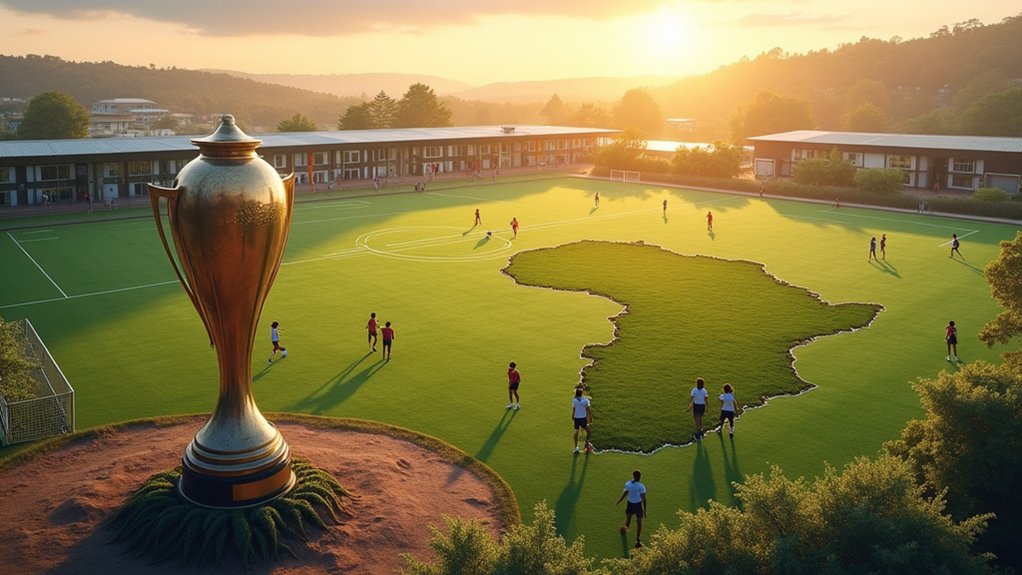

Few countries have reshaped their football landscape as deliberately as Morocco. At the center of that transformation sits the Mohammed VI Football Complex, a roughly 30-hectare facility built to full FIFA standards and recognized as one of Africa’s most advanced training centers. The estimated $65 million investment includes eight full-size pitches, futsal and beach pitches, a medical center, classrooms, and a five-star hotel. A climate-controlled indoor FIFA-standard pitch and multiple luxury hotels round out a training base that hosts both senior and youth national teams, men and women alike, under one roof. FIFA and CAF now use these facilities for coaching, refereeing, and development workshops, making Morocco a continental reference point for football education. This entire ecosystem operates under the oversight of the Royal Moroccan Football Federation, which governs national teams, competitions, and football development across the country.
That infrastructure supports an equally ambitious development model. The Mohammed VI Football Academy and its partner academies apply long-term development principles that combine technical, tactical, physical, and psychosocial training. This academy plays a central role in nurturing Morocco’s football talent and supporting the national talent pipeline from youth to senior levels. Scouting programs span 12 regions, connecting club academies to national pathways so promising players are identified early and tracked consistently. Sports-studies programs run jointly with the Ministry of National Education let young athletes train and study full-time, folding elite football into everyday schooling. Around 155 U15 and U17 girls live and train at the Mohammed VI Complex, receiving daily schooling, medical care, and boarding, a structure rarely seen for female players anywhere on the continent.
Women’s football, in particular, has moved from the margins to the center of national strategy. The annual budget for the women’s game has grown roughly tenfold, to about $65 million, one of the largest such investments in Africa. Morocco professionalized its top women’s league in 2020 and has since built two tiers of fully professional competition, a structure that sets a new global benchmark. New training villages and expanded club funding support this shift, while a coaching initiative has produced more than 135 qualified women coaches, strengthening technical leadership from within.
Together, these efforts have also raised hosting standards, with Morocco’s recent AFCON widely seen as proof that African tournaments can match international benchmarks in quality and organization.
Get the Atlas Lions Weekly
The biggest Morocco football stories, player updates and analysis—delivered to your inbox every Sunday.