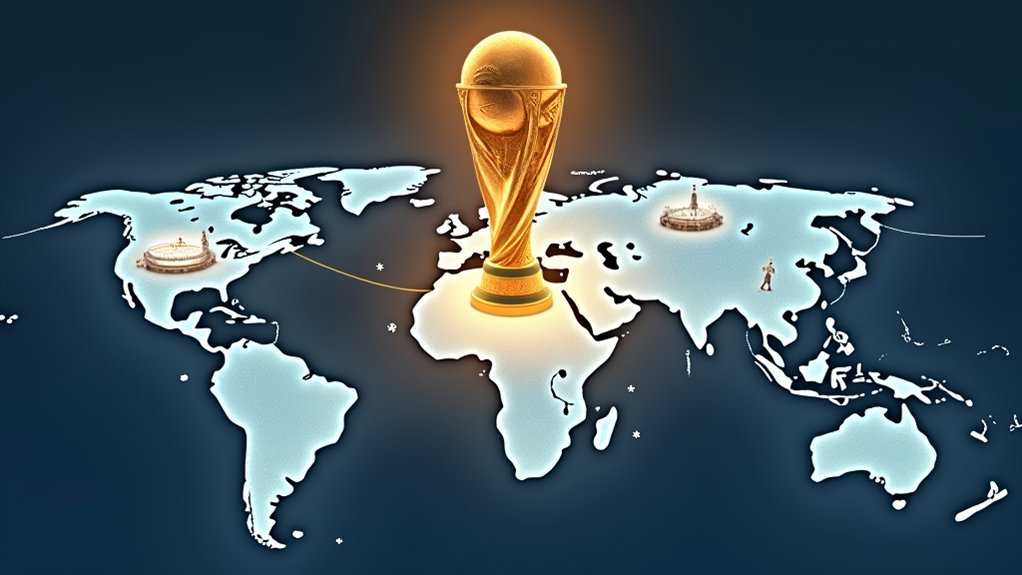

The 2030 FIFA World Cup will stretch across three continents, a first in the tournament’s history. Morocco, Portugal and Spain will serve as the primary hosts, staging the bulk of the matches following official confirmation by FIFA and ratification at an Extraordinary FIFA Congress. Alongside them, Argentina, Paraguay and Uruguay will each host a single centenary match, expanding the tournament to six countries in total. Europe, Africa and South America will all take part, a spread FIFA leadership has described as a symbolic gesture uniting three continents around the World Cup’s 100th anniversary.
Six countries, three continents, one centennial celebration: the 2030 World Cup unites Europe, Africa and South America like never before.
That anniversary is central to the format. The first World Cup was played in Uruguay in 1930, and the centenary matches are designed to honor that history. Uruguay will host its match at Estadio Centenario in Montevideo, the same stadium built for the original 1930 final. Argentina, the runner-up that year, will host at Estadio Monumental in Buenos Aires. Paraguay’s match will take place at Estadio Osvaldo Domínguez Dibb in Asunción, a fitting choice since the city is home to CONMEBOL’s headquarters. Once these three opening matches conclude, all participating teams will travel to Spain, Portugal and Morocco for the remainder of the tournament.
The joint bid behind this structure is officially known as Yalla Vamos 2030. It began as a European partnership between Spain and Portugal before Morocco joined in March 2023, having earlier considered a solo bid. Morocco’s inclusion reflects the country’s emergence as a football powerhouse on the African continent in recent years. The process started in 2020, and FIFA’s Council backed the joint proposal on 4 October 2023. Hosts were formally confirmed on 11 December 2024. A separate bid from South American nations for a full centenary tournament was ultimately set aside in favor of this hybrid model, which combines the Morocco-Portugal-Spain bid with limited South American fixtures.
As main hosts, Morocco, Portugal and Spain receive automatic qualification, pending completion of bidding formalities and Congress approval. UEFA and CAF will lead the main tournament phase, while CONMEBOL oversees the centenary matches. Together, the arrangement creates a tournament unlike any before it, blending modern football infrastructure with a direct tribute to where the World Cup all began a century ago.
Get the Atlas Lions Weekly
The biggest Morocco football stories, player updates and analysis—delivered to your inbox every Sunday.


