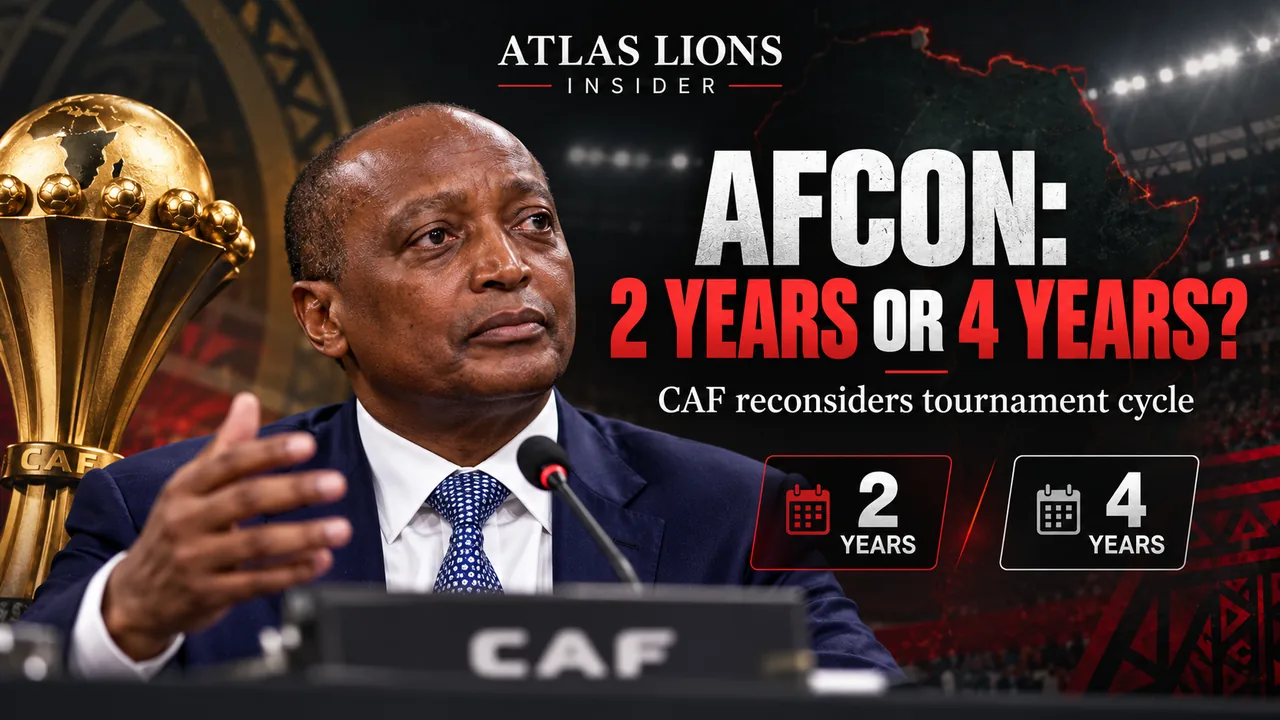

The Confederation of African Football (CAF) is reconsidering its decision to stage the Africa Cup of Nations every four years, raising the possibility of a return to the tournament’s traditional two-year cycle.
Update — October 30, 2026: CAF has now officially reversed its four-year AFCON plan and confirmed the return to a two-year cycle. Read our latest report on CAF’s decision and what it means for Morocco.
CAF president Patrice Motsepe confirmed the discussions on Friday, October 9, during the organisation’s three-day strategy conference in Cape Verde.
The announcement comes less than a year after CAF outlined plans to reduce the frequency of its main international competition following the 2028 edition.
No reversal has been formally approved, and the existing tournament schedule remains in place.
Motsepe reopens debate over AFCON schedule
Speaking at the conference, Motsepe acknowledged that CAF officials had been reviewing several aspects of the continental football calendar, including the decision to move AFCON to a four-year cycle.
“We are looking at everything, including having the AFCON coming back every two years,” Motsepe said, as reported by the Associated Press.
The remarks represent a possible change in direction from CAF’s announcement in December 2025.
Under that plan, AFCON would be held in 2027 and 2028 before switching to a four-year schedule, with subsequent editions planned for 2032 and 2036.
The proposal was intended to make room for a new annual African Nations League, which CAF presented as an opportunity to generate additional revenue and provide more regular international competition.
However, the decision drew criticism from parts of African football, where AFCON’s long-established two-year format has remained an important part of the international calendar.
CAF has not indicated when a final decision on the tournament’s frequency will be made.
What could change for Morocco?
For Morocco, the immediate competitive schedule remains unaffected.
The Atlas Lions are currently competing in the qualifiers for the 2027 Africa Cup of Nations, which will take place in Kenya, Tanzania and Uganda from June 19 to July 17, 2027.
Mohamed Ouahbi’s side began their Group A campaign with consecutive 2-0 victories against Gabon and Lesotho, collecting six points from their opening two matches.
Morocco’s qualifying campaign continues during the November international window, with the final group fixtures scheduled for March 2027.
The longer-term implications would be more significant.
Under CAF’s previously announced four-year model, the 2028 tournament would be followed by a four-year gap before the next AFCON in 2032.
Returning to a two-year cycle would provide national teams with more frequent opportunities to compete for the continental title.
For Morocco, that would influence how future squads are developed and how coaches manage the transition between generations of players.
Ouahbi has already begun that process, combining established internationals with younger players in his 29-man squad for the opening AFCON 2027 qualifiers.
The decision would also affect preparations around the 2030 FIFA World Cup, which Morocco will co-host with Spain and Portugal.
A revised AFCON calendar would need to account for the World Cup, international qualifying windows and CAF’s proposed African Nations League.
CAF has not announced how those competitions would fit together under a revised schedule.
AFCON 2027 preparations remain unchanged
Motsepe also reaffirmed that the 2027 tournament remains scheduled to take place in Kenya, Tanzania and Uganda, despite questions raised about preparations in the three host countries.
CAF’s Executive Committee approved its competitions calendar for 2026–2030 on October 2, a week before the latest discussions in Cape Verde.
For now, Morocco’s immediate priority remains qualification for the 2027 finals, part of a continental competition in which the national team has a long-established qualifying history.
Whether the Atlas Lions will return to a two-year AFCON cycle beyond 2028 will depend on a further decision from CAF, which has yet to announce a revised timetable.
Get the Atlas Lions Weekly
The biggest Morocco football stories, player updates and analysis—delivered to your inbox every Sunday.