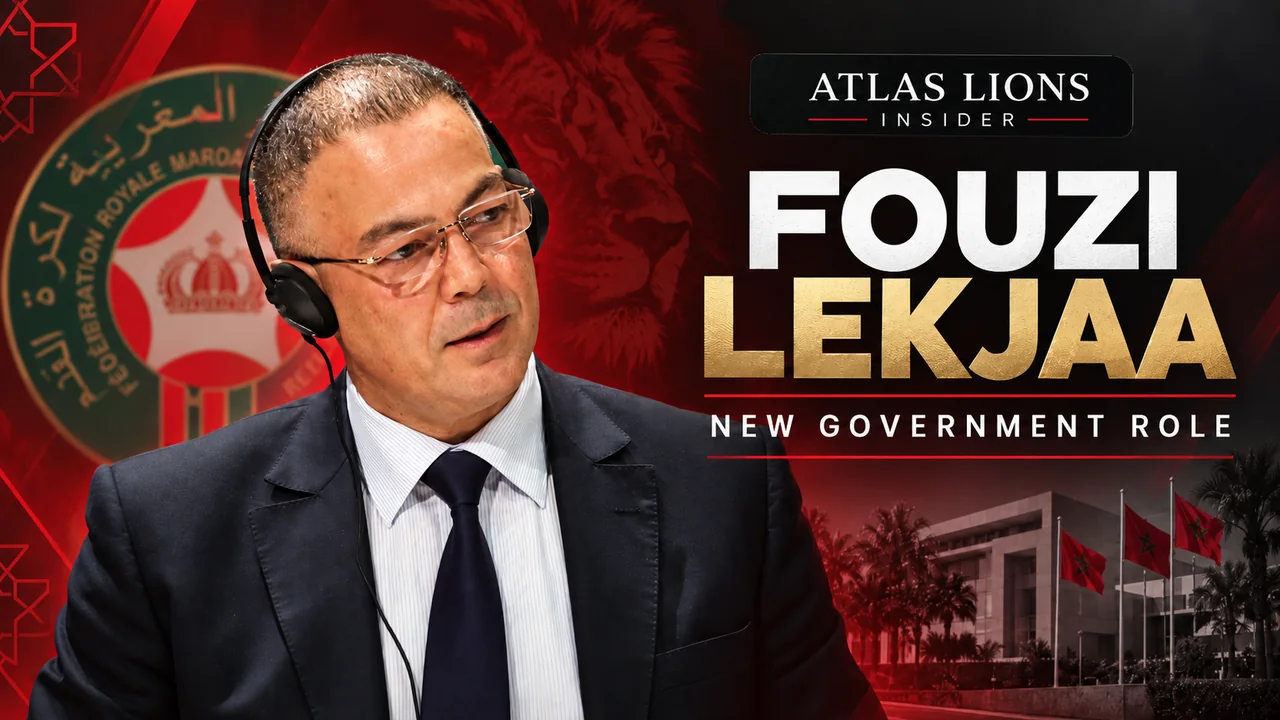
Fouzi Lekjaa, president of the Royal Moroccan Football Federation (FRMF), has been appointed Morocco’s Minister of Economy, Finance and Public Performance, adding one of the country’s most senior government positions to his existing responsibilities in football.
King Mohammed VI confirmed the appointment at the Royal Palace in Rabat on Friday, October 16, 2026, according to an official announcement from the Ministry of Finance.
Lekjaa, who has led the FRMF since 2014, now takes on a broader government portfolio at a significant moment for Moroccan football. The Atlas Lions are preparing for further 2027 Africa Cup of Nations qualifiers, while Morocco is also working toward co-hosting the 2030 FIFA World Cup.
No change to Lekjaa’s position as federation president has been announced.
A new role for a central figure in Moroccan football
Lekjaa is already an established figure in government, having previously served as Morocco’s minister responsible for the budget. His latest appointment places him in charge of the wider economy and finance portfolio, including public performance.
In football, he has overseen a period of substantial institutional investment and international progress.
Since becoming FRMF president in 2014, Lekjaa has been closely associated with the development of national training infrastructure, improvements to federation operations and Morocco’s growing influence within African and international football.
As Atlas Lions Insider previously examined, Lekjaa has consistently presented Morocco’s football development as a long-term project built around infrastructure, talent identification and organizational reform.
Morocco’s appointment as a co-host of the 2030 World Cup alongside Spain and Portugal represents another major milestone during his tenure.
What does the appointment mean for the FRMF?
The immediate football implications remain unclear.
Lekjaa’s new ministerial position does not, by itself, establish any change to the FRMF’s leadership or the management of the senior national team.
The federation has not announced his departure, a successor or changes to its existing leadership structure.
The appointment nevertheless raises a practical question: how will Lekjaa divide his responsibilities between a demanding national government portfolio and an organization overseeing Morocco’s football development?
The distinction matters because the FRMF is responsible for far more than senior-team results. Its work includes national-team organization, technical development, domestic competitions and football infrastructure.
Our guide to the FRMF and its responsibilities explains how these functions operate across different federation structures.
For the Atlas Lions, the immediate priorities remain unchanged. Head coach Mohamed Ouahbi is preparing his squad for November’s AFCON 2027 qualifiers, with Morocco seeking to build on victories over Gabon and Lesotho.
The longer-term question
Lekjaa’s expanded responsibilities also come as Morocco prepares to stage matches at the 2030 World Cup.
That creates an important intersection between government planning and football administration, particularly around the infrastructure and organizational work required for an international tournament.
However, it would be premature to assume that Lekjaa’s appointment will accelerate specific football projects or alter federation policy. No such measures have been confirmed as a consequence of the change.
For now, the development is significant because one of Morocco’s most influential football administrators has assumed a substantially larger role in government.
Whether it eventually leads to changes within the FRMF remains an open question.
Get the Atlas Lions Weekly
The biggest Morocco football stories, player updates and analysis—delivered to your inbox every Sunday.